
Pending 30, settled 8: count one round once in the return ledger
Published — UTC

A round can appear more than once as its status changes. An early displayed amount and a later settled credit may refer to the same event. Adding them together can create a return that the account never received.
Follow the identifier, not the row count
In this original example, round R-42 costs 2 units. A first history view labels an amount of 30 units as provisional. A later view records the same round as settled with an 8-unit credit. These are invented records, not a tested game or operator.
| Round ID | Status | Displayed amount | Use in settled return total? |
|---|---|---|---|
| R-42 | Provisional | 30 | No |
| R-42 | Settled | 8 | Yes, once |
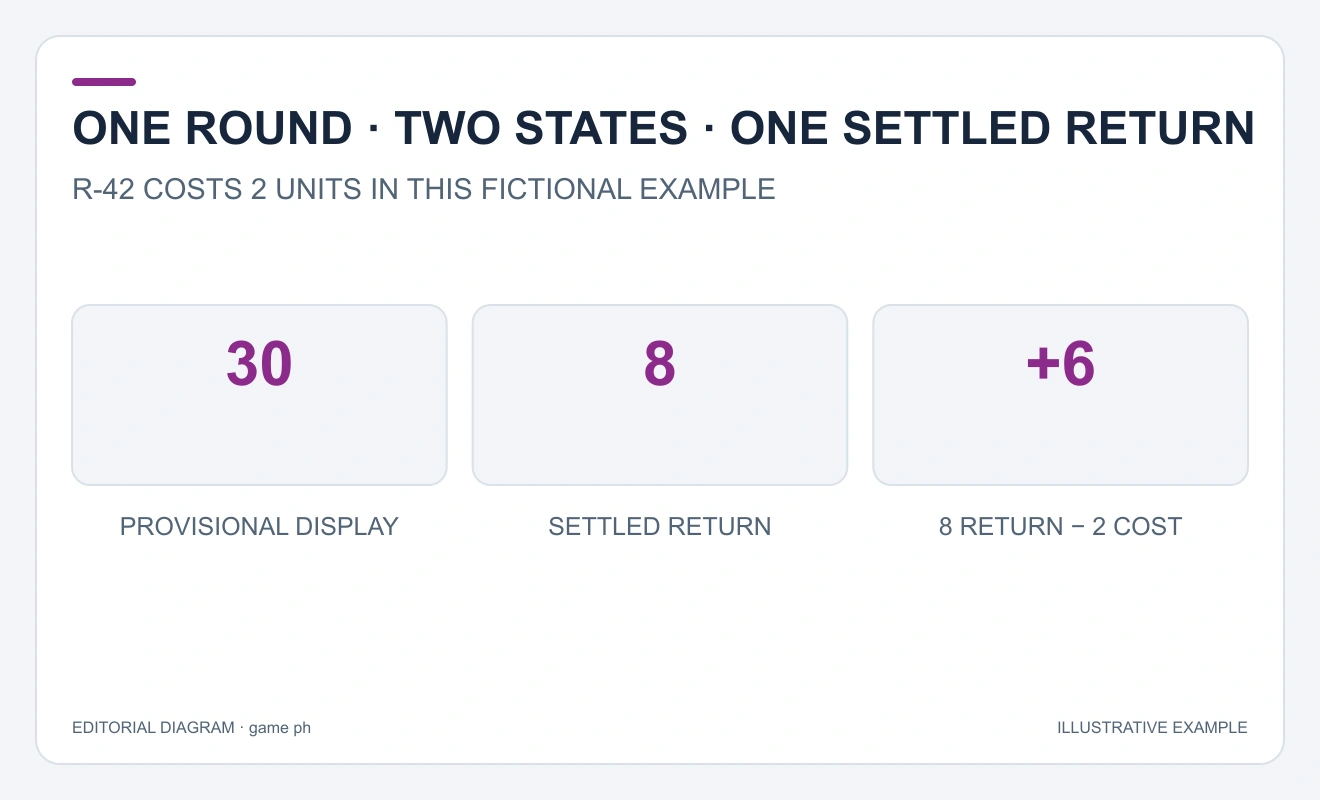
The settled example returns 8 against a 2-unit cost, giving a 6-unit net. It does not return 38. Keep the provisional row as evidence of the earlier display, but do not classify it as another credited award.
Do not silently replace an uncertain field
If the record does not clearly identify the 30 as provisional, retain both versions and mark the discrepancy unresolved. Matching IDs alone cannot establish which source is authoritative or why the amount changed. Check the final settlement record, its timestamp and the game’s applicable rules.
The British account-information reference distinguishes transaction history and game results. It is a reference for record clarity, not confirmation that a particular local display is an account credit.
A practical state log
Keep event identity, status, amount type, currency and source timestamp in separate columns. Use a settled-total column that includes only confirmed monetary entries. A new retrieval time belongs in the audit log; it should not generate a second round.
A wallet check catches the invented extra return
With an opening balance of 100, the accepted cost of 2 leaves 98. A confirmed credit of 8 leaves 106. Adding the provisional 30 would predict 136, which disagrees with the defined ledger. This check assumes no other account movements during the interval; an actual report must include any that occurred.
A revised total is different from an adjustment
Suppose a later record corrects the settled return from 8 to 6. A replacement total of 6 means the final return is 6 and net is 4. A separate adjustment of −2 linked to the earlier credit also gives 8 − 2 = 6. Those are two possible representations of the same correction, not two additional deductions to apply together.
Without an amount-type field, “6” might describe a total, an additional credit or something else. Preserve the ambiguity and request the transaction definition instead of selecting the interpretation that makes the balance look right.
Use an event key with enough context
Keep the provider or game identifier and account-history scope beside R-42. Another game may reuse the same short round label. Conversely, two retrieval timestamps can be snapshots of one unchanged event. Store source timestamps for traceability while counting confirmed financial entries by their actual identity and signed effect.