
GUIDE · game ph
One paid spin, several tumbles: avoid counting the round twice
Several tumble events can belong to one paid slot round. A history with three events therefore does not automatically mean three stakes. The key is to separate the round’s paid entry from its component awards and any cumulative total.
For the topic overview, see Is the animation or new paid round visible?.

Why a new board can belong to the same paid round
The tumbling section on page 5 of the 5 Rabbit Megaways overview describes replacing winning symbols and evaluating the resulting board without an additional cost, repeating while wins continue. Checked on 8 October 2026, that description supports this distinction between an initial entry and subsequent evaluations. It does not establish the format of an operator’s account history.
The word “game” in an animation or event log can refer to an evaluation rather than a new paid purchase. Follow the transaction fields and parent-round relationship instead of counting screen changes as charges.
A fictional ledger with one 10-unit stake
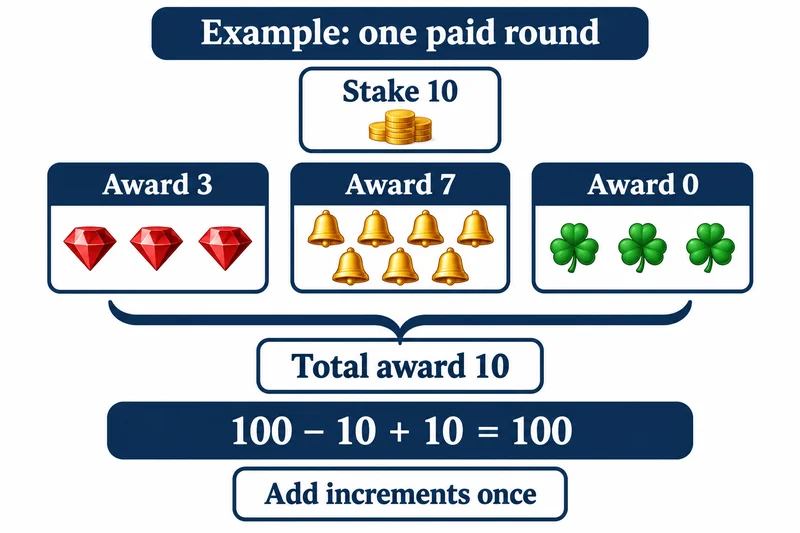
Assume round R-21 begins with a 100-unit balance, one 10-unit stake and no deposits, withdrawals, bonuses or other activity. Awards below are invented incremental values. Scatter payments and bonus features are deliberately outside this exercise.
| Event under R-21 | New stake debit | Award added at this event | Cumulative round award |
|---|---|---|---|
| Paid opening evaluation | 10 | 3 | 3 |
| First tumble evaluation | 0 | 7 | 10 |
| Final non-winning evaluation | 0 | 0 | 10 |
Add the incremental awards once: 3 + 7 + 0 = 10. The final balance is 100 − 10 + 10 = 100. This describes the invented ledger only; it does not predict a return or represent a tested game session.
The two common double counts
First, adding the cumulative column gives 3 + 10 + 10 = 23. That is wrong because the later cumulative entries already include the earlier award. Use either the final cumulative total or the sum of the separate increments, not both.
Second, charging 10 for every event would deduct 30 even though the example contains only one stake debit. Three evaluations are not three paid starts under these assumptions. A real record with additional debit entries would need to be examined on its own evidence.
When the ledger does not reconcile
Before alleging a missing award, check whether the figure is an increment, a running total or a final total. Confirm that all entries belong to the same round and that the recorded status is complete. A pending row should not be silently converted into a zero.
The round-identity and timestamp guide helps align the records before this arithmetic. If a history uses separate sub-event identifiers, preserve those identifiers while identifying their parent. Matching amounts alone do not prove two entries are duplicates.
Keep separate transactions outside the round reconciliation. A deposit can raise a wallet balance without being a slot award; another round can lower it without changing this round’s total. Where the system exposes only a single final figure, do not manufacture missing component events to make a detailed table look complete.
The game record guide collection contains related checks. The game ph homepage provides the broader navigation.
Source-based editorial research and original examples. Sources checked 2026-10-08.